Survival, Part Two
A miraculous story from history's deadliest chapter

In the echo of machine gun fire, Alexander was collapsed and bleeding, but somehow — alive. He could not speak, but after a half hour that seemed like an eternity, he heard approaching footsteps and managed to move to draw attention. His rescuers transported him to the nearest moving hospital. The doctor took one look at him and told the nurses to put him on the floor, rather than waste a bed, because he wouldn’t survive. As Alexander lay on the hospital floor that night, he remembered the doctors’ fatal proclamation and prayed until he fell asleep.
Prayer is a lifesaver.
When the doctor arrived the next morning, the nurses greeted him with news that the man he thought had no chance still lived. The medical examination revealed the miracle of Alexander’s survival. The bullet had entered his eye, missing his brain by less than a quarter inch before exiting his neck.
It was the posture of his head, bowed in prayer, which completely altered the trajectory of the bullet, saving his life. Prayer saved Alexander’s life twice, against all odds and expert opinions.
His story is an anomaly. During this period, known as Red Terror, the Red Army committed upwards of 140,000 “summary executions”. A summary execution is one in which a person is accused of a crime and immediately killed — without question and without trial. Summary executions have been common practice in every Communist regime in history.
Sparing graphic details — Alexander’s treatment and rehabilitation were tedious. He had sustained serious head trauma which resulted in irreparable damage. He was permanently blind in one eye and deaf in one ear. By December of that year, he had joined the White Army in their opposition against the Bolsheviks. Alexander wrote in an autobiographical excerpt: “There were many attacks, many dangers, but I was no more hurt, sick, or wounded.”
But the White Army seemed destined to fail. The Communist forces had attacked and overtaken Poland before mobilizing an army of two million against the White Army’s mere 150,000. Defeat was certain, and there was nothing left to do but scatter. Alexander’s regiment escaped on an Allied warship to Istanbul. He spent the next several years living as a refugee in Turkey, France, and various other parts of Europe before immigrating to Canada in 1928.
I remember the first time someone told me that “genuine Communism hasn’t really been tried” — it was my junior year of high school and I had written a research paper on the history of Communism. I blinked in shock — I didn’t know what to say. My great-grandfather would have been extinguished with the instantaneous cruelty that snuffed out a quarter of a million souls, if not for a miracle. My family line would be engraved on an epitaph among the 100 million headstones in the graveyard of Communism.
It takes privileged arrogance to dismiss an outcome that has been ubiquitous to an ideology as some kind of coincidental mistake. The logical conclusions of Marxist philosophy lead to poverty, death, and a complete dissolution of moral reason — Communism is the costliest historical proof. My great-grandfather was a living proof.
During WWII, Alexander was eager to participate; his age and previous injuries prevented typical involvement, but his fluency in German, Russian, and English made him a valuable asset. He was assigned to be an interpreter and a guard at a prisoner of war camp for captured Nazi soldiers.
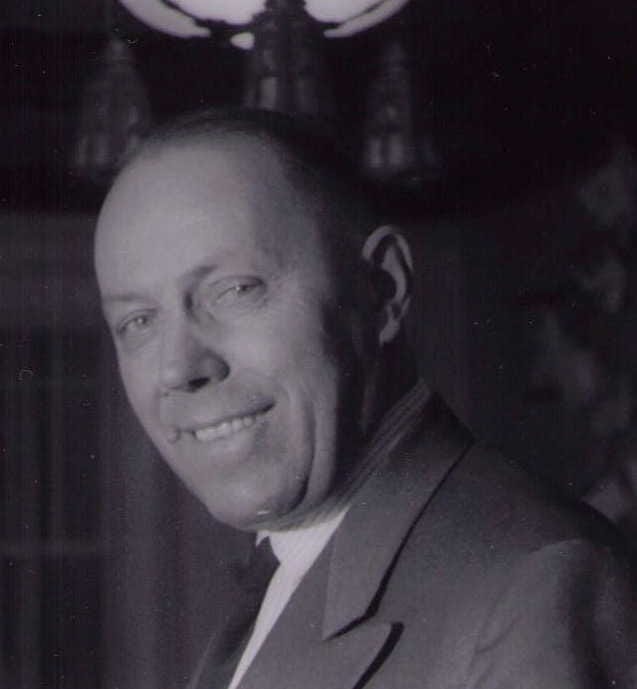
After the war he resumed his trade as an insurance salesman, and later sold real estate as well as serving as treasurer for the United Lutheran church synod of western Canada. The synod was planning to build a seminary, so he began traveling to different churches each Sunday to preach and raise funds. He preached at every United Lutheran church in Western Canada; his gregariousness made him a winsome, welcome guest in every congregation.
There’s a vivid picture of my great-grandfather that hangs in my memory — one that hangs over my grandparent’s mantle. It’s a portrait of him painted by one of the Nazi soldiers in the POW camp where he was an interpreter and a guard. It seems strange that an imprisoned soldier would paint such a venerable likeness of a prison guard as a gift, until I remember it was said of Alexander that “everyone was his friend” — and I wonder if that rang true even in unexpected places, even to undeserving people. He was quick to speak about his faith and his God — and I wonder if that rang true even to people who had been given up to the full depravity of gospel-less-ness.
His story is one of miraculous deliverance. While his execution was a death sentence of undeserved cruelty, his survival was an answered plea for undeserved mercy.
I’ve always cherished the story of his survival, and it creates impetus to tell the story of the circumstance that led to it. Many become sympathetic to certain ideologies that sound good when they do not understand the context or the conclusion of those ideas. The ideas behind the Bolshevik revolution ushered in the most oppressive regime history has ever seen — and they did not expire with the 20th century.
I wish 17-year old me had the presence of mind and the temerity to respond to the summary challenge of my anti-Communist manifesto the way my 17-year old great-grandfather had the presence of mind and the temerity to defy summary execution with a humble prayer.
But more than anything, I want it to be said of my life that it was marked by conversation with God. More than anything, I want to pray like my life depends on it…because it does.